Theme Three Blog: Where are we and where to next with reference resources?
Where Are We?

Throughout this term we have learned that the reference sections of our LLC needs our attention. Without the Teacher Librarian taking the time to familiarize themselves with the collections, we cannot introduce them into the learning with our students. I have felt lost many times in my role as the TL and some of that feeling comes from not knowing where to direct my students. A robust reference section of an elementary library has biographies, encyclopedias, dictionaries, digital indexes, maps and atlases. It is the TLs responsibility to connect students to the print formats of the resources and the digital formats our districts subscribe to as well. A very large part of my feeling of being stranded comes from challenging myself to lead my fellow colleagues. There is an abundance of resources, but if we don't know how to access them then it feels a bit like landing in a new environment and it takes a little bit of effort to learn how to thrive. LLCs are gateways to the world for all students and I for one would like to be purposeful in my use of the reference section of the library and instead of crash landing on a deserted island I would love enjoy the journey.
School libraries provide students and teachers with easy and equitable access to materials. Computerized library catalogues, electronic databases, and search engines help students and teachers find the information they need quickly and efficiently. School libraries are access points for rich and diverse resources available in various media formats, on the Internet, and through e-mail. School libraries are gateways to global information sources, acting as portals through which students and teachers find diverse ideas and perspectives from around the world. (Acheiving Information Literacy, 2006)
It is an exciting time to work in an LLC since the emphasis is on being a teacher and a little on being a librarian. Working in partnership with our colleagues makes the LLC the hub of the school. The challenge to stay current and relevant with the learning that is happening in the classroom.
I love this introduction to fostering literacies to empower life-long learners because as we move through the research stages it becomes apparent that students are involved in a reading culture when they research. Using a variety of literacy skills is empowering. Knowing how to use critical thinking skills when it comes to all literature whether it be print or digital is important. We are also in an environment where we need to know what our students are using as their reference resources. Wikipedia appears to be here to stay and even at the elementary level it is being used. "Many librarians distrust the online work (Wikipedia)--if anyone can contribute information, the articles will be inaccurate, they say. So many media specialists have banned using the site. There are two problems with this. For one, study after study has found that Wikipedia is, in fact, reasonably accurate as a general knowledge source. And students are just going to use it anyway." (Harris, 2007). It is part of our responsibility as a TL to use sites that are reliable, but also to help students be discriminatory in their reading and use strategies to determine what is the truth.

It is an exciting time to work in an LLC since the emphasis is on being a teacher and a little on being a librarian. Working in partnership with our colleagues makes the LLC the hub of the school. The challenge to stay current and relevant with the learning that is happening in the classroom.
You Are Here
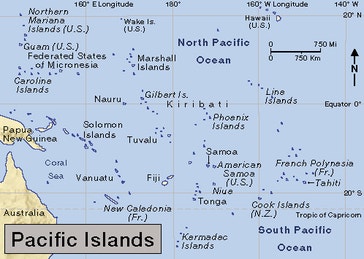
Knowing where you are and the resources you have is of utmost importance. Once I discovered the digital bundle that our school subscribed to I was much better able to plan out my support for the teachers and students as they move forward in their research. Until then I was trying to find myself in this map above on any one of the many islands in the Pacific! This map was located using World Book for Students. What I have discovered is that having multiple ways for students to find information and make sense of it is paramount. The interenet is not always available and having a strong reference section in the LLC that is appealing, and useful, is key. I have found that for my LLC Crabtree is an excellent source for my LLC. Whether it be a dictionary, an atlas, or a biography, Riedling uses an evaluation criteria that typicaly includes authority, format, currency and accuracy. Ensuring that a print or digital reference resource is written by a company or person that is known to be trustworthy, making sure the presentation is appropriate for the audience, making sure the information is less than five year old and of course factual are all imperative for a strong resource.
New technologies and evolving methods of communication and sharing drive expanding understandings of literacy. This reality has made the refinement and demonstration of strong literacy skills ever more important for learners. Exploring and connecting various ways of knowing and learning is part of the process of personalizing learning and involves embracing new literacies and skills. The school library learning commons has a leading role in assisting learners to hone and apply an expanded notion of literacy as well as fostering an active reading culture. (Leading Learning, 2014)
Where to Next?
I love planning a trip, the LLC schedule, a timetable and a project collaboratively with teachers and students. Our final assignment and next blog post takes us into what we will do with the information we have garnered in this course. Our final weeks have been spent reflecting on what we want our LLC reference section to look like and how we want the LLC space used. For myself the section is going to be spruced up with mapping resources and encyclopedias specific to countries and cultures since that is where the interest currently lies. "Empowering Learners views one role of the school library media specialist as a teacher collaborating with students to build information literacy skills and identify appropriate tools for collecting, communicating, finding, and using information" (AASL, 2009). It is not enough to have a subscription to digital resources and a pretty shelf of reference materials. They need to be needed and in the hand of the learners. These last few weeks of this course have led me to seek input via email from the teachers as to how they would like to tweak my schedule for next year. Where can I best be used to facilitate the research so they can be successful in their inquiry based projects? How can I help keep our students safe at the elementary level? Knowing about the deep and dark web led me to the conclusion that planning where we are going next is important. Students need the skills to navigate our reference resources wisely. Our students need the far reaching skills that they can use in their own independent inquiry based projects. As the TL I am happy to be the tour guide.
I am looking forward to our next trip together!
Works Cited
AASL. (2009). Empowering Learners: Guidelines for School Library Media Programs. Chicago. p. 20.
Achieving Information Literacy. (2006). Canadian Association for School Libraries. p6. Retrieved from :http://accessola2.com/SLIC-Site/slic/ail110217.pdf
Canadian Library Association. (2014). Leading Learning: Standards of Practice for School Library Learning Commons in Canada. p. 17. Retrieved from:http://llsop.canadianschoollibraries.ca/fostering-literacies/
Harris, C. (2007) Can we Make Peace with Wikipedia? School Library Journal, 53 (6), 26
Riedling, A. (2013). Reference skills for the school library media specialist: Tools and Tips, (Third Edition). Santa Barbara, CA: Linworth.
Canadian Library Association. (2014). Leading Learning: Standards of Practice for School Library Learning Commons in Canada. p. 17. Retrieved from:http://llsop.canadianschoollibraries.ca/fostering-literacies/
Harris, C. (2007) Can we Make Peace with Wikipedia? School Library Journal, 53 (6), 26
Riedling, A. (2013). Reference skills for the school library media specialist: Tools and Tips, (Third Edition). Santa Barbara, CA: Linworth.


Well done reflection on your key learning over the last theme of our course. Your highlights, evaluations, discussions and goals for the future are all well informed and demonstrative of your deep commitment to this role and supporting your school community. You did a good job connecting the readings of the modules with your own awareness and plans for the future. Your personal reflection on centering yourself and preparing for the next phase was very authentic and valuable.
ReplyDeleteThat's really great that you have been reaching out to teachers asking for their input-some people struggle with that but I think it's so important.
ReplyDelete